
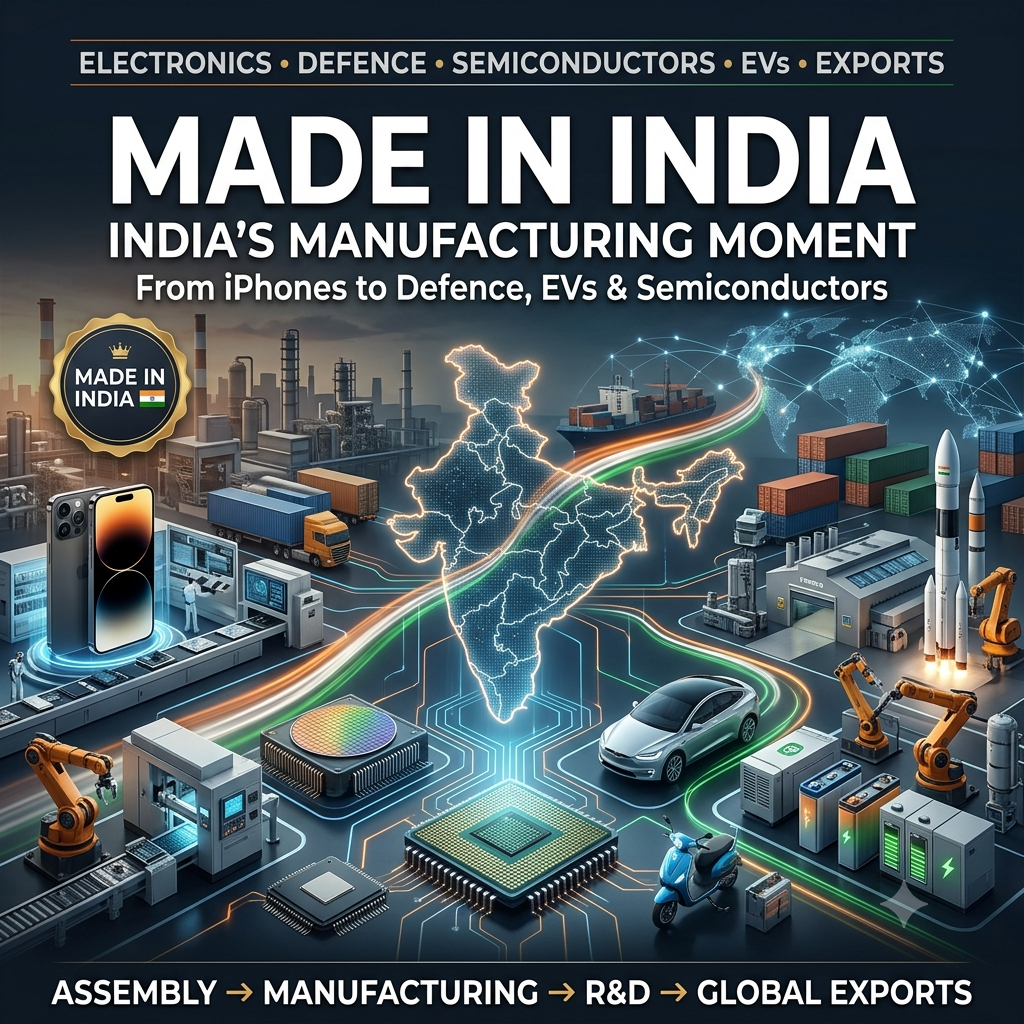
September 2026: The Month India Proved It’s Not Just a Market—It’s a Manufacturing Powerhouse
In a stunning series of announcements over the past week, India has cemented its position as a global manufacturing destination across sectors—from consumer electronics to defence hardware. As Apple prepares to unveil the iPhone 18 series (assembled in India), Adani Defence signs a landmark ammunition deal, and Thales partners with Kalyani to manufacture combat rockets domestically, one message is clear: Made in India is no longer a slogan—it’s a global reality.
This is the story of how India transformed from an assembly hub to a full-stack manufacturing powerhouse—and why September 2026 will be remembered as the turning point.
📱 Apple’s India Bet: iPhone 18 Pro Assembled in India Before Global Launch
The Headline
Apple is set to unveil the iPhone 18 Pro, iPhone 18 Pro Max, and its first foldable iPhone Ultra at its “Surprise and Shine” event on September 9, 2026 (10:30 PM IST). But here’s what most people missed: All versions of the iPhone 18 lineup are being assembled in India—including the premium Pro and Pro Max models—before the global launch.
The Numbers
- 53% increase in iPhone production in India last year (2025)
- 100% of iPhone 17 lineup assembled in India, including Pro models
- Three major suppliers in India: Foxconn, Tata Electronics, and Pegatron
- First time ever: iPhone 18 Pro models tested in India before launch
Why This Matters
This isn’t just about assembly—it’s about supply chain integration. When Apple trusts India with pre-launch testing of its most advanced devices (including the foldable iPhone Ultra), it signals:
- Confidence in Indian manufacturing quality
- Integration into Apple’s global R&D pipeline
- India as a strategic alternative to China for premium device manufacturing
The Tata Electronics Factor
Tata Electronics, which acquired Apple supplier facilities from Taiwan’s Pegatron, is now a critical part of Apple’s supply chain. Despite a June 2026 ransomware attack that leaked 204,300 files (including iPhone 18 component designs and Tesla manufacturing specs), Apple has continued expanding its India operations—proof that the strategic partnership is too valuable to abandon.
Quote from Industry Analyst: “Apple’s growing reliance on India for manufacturing and suppliers underscores the country’s rising importance in production for current and future devices. India is no longer Plan B—it’s Plan A.”
🔫 Adani Defence & IRRPL: AK-203 Rifles to Fire Indian-Made Ammo
The Deal
On September 5, 2026, Adani Defence & Aerospace entered a five-year agreement with Indo-Russian Rifles Private Limited (IRRPL) to supply indigenously manufactured 7.62x39mm ammunition for the AK-203 assault rifles being produced in India.
The Context
- AK-203 rifles are being manufactured at IRRPL’s Amethi (Uttar Pradesh) facility—a joint venture between India’s OFB and Russia’s Kalashnikov Concern
- Over 600,000 AK-203 rifles have been ordered by the Indian Army
- Until now, ammunition was imported from Russia—creating supply chain vulnerabilities
Why This Is a Game-Changer
- Complete Indigenous Ecosystem: Rifles + Ammo, both made in India
- Strategic Autonomy: No dependency on Russian ammo imports during conflicts
- Export Potential: India can now export complete rifle+ammo packages to friendly nations
- Atmanirbhar Defence: Aligns with PM Modi’s vision of self-reliant defence manufacturing
Quote from Defence Ministry: “This landmark agreement ensures that our armed forces will have uninterrupted access to high-quality ammunition for the AK-203, manufactured entirely within India. This is Atmanirbhar Bharat in action.”
🚀 Thales + Kalyani: French Combat Rockets to Be Made in India by 2027
The Partnership
On September 3, 2026, French defence giant Thales partnered with Kalyani Strategic Systems Limited (KSSL)—a Bharat Forge subsidiary—to manufacture combat-proven 70mm rocket systems in India.
The Deal Details
- Technology Transfer: Both unguided and precision laser-guided variants
- First Indian-Assembled Rocket: Expected by early 2027
- Production Facility: Dedicated manufacturing line in India
- Strategic Alliance: Covers technology cooperation, local production, and value creation
Why This Matters
- Advanced Technology Transfer: 70mm laser-guided rockets are cutting-edge defence technology—rarely shared with foreign partners
- Make in India for Defence: Aligns with government’s push for domestic defence manufacturing
- Export Hub Potential: India can manufacture these rockets for export to African, Middle Eastern, and Southeast Asian nations
- Jobs & Skills: High-tech manufacturing creates skilled employment in defence sector
Quote from Thales CEO: “India is not just a market for Thales—it’s a strategic manufacturing partner. This alliance demonstrates our commitment to building defence capabilities in India, for India and the world.”
💻 India’s $13 Billion Semicon 2.0 Mission: Chips Made in India
The Announcement
On September 8, 2026, the Government of India launched the $13 billion (₹1.08 lakh crore) Semicon 2.0 Mission to strengthen domestic chip manufacturing and design.
The Scope
- Fabrication Plants (Fabs): Support for semiconductor fabs in India
- Equipment & Materials: Domestic manufacturing of chip-making equipment
- R&D Investment: Funding for chip design and process technology
- Workforce Development: Training 100,000+ semiconductor engineers by 2030
- Goal: Reduce import dependence and position India as a major global semiconductor hub
Why This Is Critical
- Current Reality: India imports 100% of its semiconductors (chips power everything from phones to cars to defence systems)
- Global Context: US, China, EU, and Japan are all investing billions in domestic chip manufacturing
- Strategic Importance: Chips are the “oil of the 21st century”—whoever controls chip supply controls technology
Quote from IT Minister: “Semicon 2.0 is not just about manufacturing—it’s about building a complete semiconductor ecosystem in India, from design to fabrication to packaging. This will make India self-reliant in the most critical technology of our time.”
🚗 EV Manufacturing Boom: Ola, Ather, TVS Lead India’s Electric Revolution
Recent Launches (September 2026)
- Ola Electric: Launched S1Z e-scooter at ₹79,999 using LFP cells from its own Gigafactory (first Indian company to make its own battery cells)
- Ather Energy: Introduced Konarc, mass-market electric scooter starting at ₹99,999
- TVS iQube: Reached 1 million customers and launched iQube MillionR Special Edition
- JSW MG Motor: Launched MG Hector Tomahawk in EV and PHEV variants with battery-as-a-service model
- Simple Energy: Launched Wave family electric scooter at ₹1.10 lakh
The Bigger Picture
- Yuma Energy: Raised $35 million from Magna International to expand battery swapping infrastructure across India (2,500+ charging/swapping units across 400+ locations)
- AutoNxt: Launched Autonomous Electric Aero Tiller for agriculture—India’s first self-driving farm equipment
Why This Matters: India is not just assembling EVs—it’s building the entire ecosystem: batteries, motors, charging infrastructure, and even autonomous systems.
🧴 Indian Brands Taking On Global Giants: Reliance Enters Ice Cream Market
The Launch
On September 1, 2026, Reliance Consumer Products Limited (RCPL) entered India’s ice cream market with Bombay Creamery—an accessible premium dairy brand priced from ₹10.
The Strategy
- Initial Launch: Western India (Maharashtra, Gujarat)
- Expansion: Pan-India rollout planned
- Price Point: ₹10-₹150 range (competing with Amul, Kwality Wall’s, and premium brands like Naturals)
- Reliance Retail Advantage: Distribution through 18,000+ Reliance Retail stores and JioMart
Why This Is Significant
Reliance is now competing in:
- Telecom: Jio (disrupted Airtel, Vodafone)
- Retail: Reliance Retail (competes with Amazon, Flipkart)
- FMCG: Reliance Consumer (competes with HUL, P&G, Nestlé)
- Ice Cream: Bombay Creamery (competes with Unilever, Amul)
Pattern: Reliance identifies fragmented, high-volume consumer markets and enters with scale, pricing power, and distribution muscle.
The Common Thread: India’s Manufacturing Moment
What connects iPhones, defence rockets, semiconductors, EVs, and ice cream? They all represent India’s transformation from a consumption-driven economy to a production-driven powerhouse.
The Shift
| Era | India’s Role | Example |
|---|---|---|
| 1990s-2000s | Market for imports | Buy iPhones from USA, cars from Japan |
| 2010s | Assembly hub | Assemble iPhones from Chinese parts |
| 2020s | Manufacturing + R&D | Design chips, make rockets, build batteries in India |
| 2026+ | Global manufacturing hub | Export iPhones, defence systems, EVs, chips to the world |
Tip for mobile users: Swipe horizontally across the comparison table to view all columns.
The Drivers
- China+1 Strategy: Global companies diversifying supply chains away from China
- PLI Schemes: Production-Linked Incentive schemes across electronics, defence, pharma, auto
- Skilled Workforce: India’s engineering talent pool at competitive costs
- Domestic Market: 1.4 billion consumers provide scale for manufacturers
- Government Push: Make in India, Atmanirbhar Bharat, Semicon India, Defence corridors
💡 Did You Know?
Interesting Facts About Made in India in 2026
- ✓ iPhone 18 Pro models were tested in India before global launch—the first time Apple has conducted pre-launch testing of premium iPhones outside California, highlighting India’s integration into Apple’s global R&D pipeline.
- ✓ Tata Electronics’ ransomware attack leaked 204,300 files including iPhone 18 component designs and Tesla manufacturing specs—yet Apple continued expanding India operations, proving the strategic partnership is too valuable to abandon despite security concerns.
- ✓ India’s AK-203 rifle production at Amethi employs over 5,000 workers and has a capacity to produce 100,000+ rifles annually—making it one of the largest small arms manufacturing facilities in Asia.
- ✓ Thales’ 70mm laser-guided rockets are used by NATO forces in combat operations—technology transfer to India is rare and signals France’s strategic trust in Indian defence manufacturing capabilities.
- ✓ Semicon 2.0’s $13 billion budget is larger than the GDP of 50+ countries—making it one of the largest government investments in semiconductor manufacturing globally, alongside US CHIPS Act ($52B) and EU Chips Act ($43B).
- ✓ Ola Electric’s Gigafactory in Hosur, Tamil Nadu, is Asia’s largest two-wheeler battery cell manufacturing facility—producing LFP (Lithium Iron Phosphate) cells that power Ola S1Z scooters at ₹79,999, undercutting competitors by 20-30%.
- ✓ Reliance’s Bombay Creamery enters a ₹25,000 crore Indian ice cream market dominated by Unilever (Kwality Wall’s), Amul, and Nestlé—but Reliance’s 18,000+ retail stores and JioMart distribution give it instant pan-India reach.
- ✓ Yuma Energy’s battery swapping network (2,500+ stations across 400+ locations) is larger than Tesla’s Supercharger network in India—proving that battery swapping, not just charging, is critical for India’s EV adoption.
- ✓ Kalyani Strategic Systems (Bharat Forge) is now manufacturing defence systems for both France (Thales rockets) and Belgium (FN Herstal small arms)—making India a defence export hub for European NATO members.
- ✓ Apple’s India production increased 53% in 2025—the fastest growth rate for any Apple manufacturing location globally, outpacing China, Vietnam, and India combined.
The Road Ahead: What’s Next for Made in India?
Short-Term (2026-27)
- iPhone 18 sales in India: Expected to break records with “Made in India” premium models
- First Indian-assembled Thales rockets: Early 2027 rollout
- Semicon 2.0 fabs: First semiconductor fabrication plant announcements expected
- AK-203 + Indian ammo: Full-scale production for Indian Army
Medium-Term (2027-30)
- India as iPhone export hub: 30-40% of global iPhone production from India (vs 5-7% in 2023)
- Defence exports: $5-10 billion annual defence exports (rockets, rifles, missiles, radars)
- Semiconductor self-reliance: 20-30% of India’s chip demand met domestically
- EV dominance: India becomes world’s largest two-wheeler EV manufacturer and exporter
Long-Term (2030+)
- Top 3 global manufacturing hub: India alongside China and USA
- Technology exporter: Not just manufacturing, but Indian-designed chips, defence systems, EVs
- Atmanirbhar ecosystem: Complete value chains in electronics, defence, pharma, auto, renewable energy
Final Thoughts: This Is India’s Decade
September 2026 will be remembered as the month India proved it’s not just a market of 1.4 billion consumers—it’s a manufacturing powerhouse capable of producing the world’s most advanced products:
- iPhones that compete with China-made quality
- Defence rockets that meet NATO standards
- Semiconductors that power the digital age
- EVs that lead the green transition
- Consumer brands that challenge global giants
The narrative has shifted from “Can India manufacture?” to “What can’t India manufacture?”
Made in India is no longer a tagline. It’s a global reality.
And this is just the beginning.
Jai Hind. Jai Manufacturing. 🇮🇳
Follow us for more updates on India’s rise as a global manufacturing hub.